Ghostwriting in the Age of Mechanical Reproduction
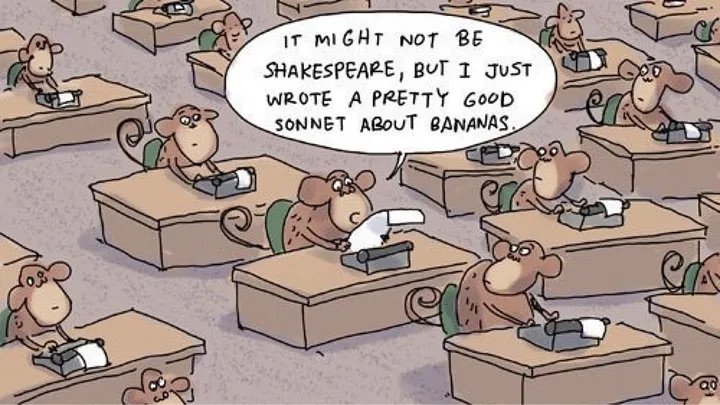
image source: Jonathan Nuttall, Medium
Perhaps the very best thing about ghostwriting is that you’re never precious about it: If a client doesn’t like a sentence, you can’t take it as a referendum on your intelligence or taste because that sentence isn’t really yours. So you can imagine my disorientation when I took offense to a client’s edit in a recent piece I filed. They flagged that I had used a certain rhetorical construction more than once. I had, and I will be the first to admit that over-reliance on a device is lazy writing and should be avoided. Then they said it sounded like LLM writing.
It really wigged me out. And it did feel a bit personal.
I’m far from the first to point out the broader issue. AI is trained on patterns; good writing uses, and to a certain extent depends on, patterns. This we know. But I do want to introduce a complication, one I’m currently banging my head against daily.
In the face of the despairing information about how we now relate to language (the idea that LLM writing : individuated syntax :: GPS : innate sense of direction fills me with dread), the advice appears to be “If you don’t want to sound like AI, write weird! Let your freak flag fly, girlfriend!”
But I’m a ghostwriter. For anything I write to be successful, it must have mass appeal and at least some degree of, yes, blandness. I can’t write an argument for a CEO that sounds like an e.e. cummings poem; that literally defeats the purpose—my purpose. In fact, this is something I really value about my job: I am forced to pare back my tendencies towards flowery language or purple prose. Having to write more “basically” has made me a better writer.
The flipside is that I now run the risk of being accused of being a machine.
The issue is aesthetic, sure, and I am melancholic about the loss of the em dash, etc., but it is also epistemic. In a very real way, it is personal. Humans are hardwired to recognize and interpret patterns. Now that we’ve trained machines to do the same, we are suspicious of the very patterns we are hardwired to recognize.
For the record, the construction my client flagged was good ol’ contrastive negation—“not as an x, but as a y.” But listen: This is a useful device! When used well, (sparingly and with purpose) it can sharpen contrast in a way that helps a reader understand a thing by pointing out what that thing is not. It’s a piece of scaffolding, really. A reader shouldn’t really notice it at all. Used poorly—or more precisely, used too much without a good reason—it sticks out, and is, in a word, ugly.
This is where I agree with my client. I had used it more than once, and thus, by my own standards, it was icky. But the important distinction is this: Good, human writers do make use of contrastive negation. More to the point, they should. They should use it intentionally; not to signal something, but to help a reader understand. (See what I did there?)
Contrastive negation—like the em dash and the “rule of threes”—is a tool; what matters is whether the writer knows they’re using it. By using these tools as markers and making those markers ubiquitous, AI has chipped away at their utility. When patterns are everywhere, they stop reading as craft and start reading as default.
Language is, of course, a living thing. I accept semantic drift as a fact of life (though I stubbornly and pedantically use “hopefully” for its original meaning only) even if I don’t like it. This, however, feels different. It’s structure that’s changing rather than vocabulary. Or, put differently, it’s style that’s changing, not meaning. And it’s happening so fast. A construction’s metamorphosis from effective, to widespread, to suspicious takes weeks rather than decades.
The style of a piece is specific to that person writing that thing for that audience at that historical moment. One doesn’t so much “have” a voice as one continues, based on one’s context, to shape it. When AI imitates it, it is flattening and cheapening something collective and dynamic.
Here I will allow myself a small sentimental indulgence: “Style” is fundamentally human. I don’t mean “human” like it’s something we innately possess our bones, but rather “human” as in humanity. Not only could it not exist without humans, style could not exist without shared human experience. The style of a piece is specific to that person writing that thing for that audience at that historical moment. One doesn’t so much “have” a voice as one continues, based on one’s context, to shape it. When AI imitates it, it is flattening and cheapening something collective and dynamic.
(This points to a small grief that I don’t want to overstate but can’t ignore: it feels like a certain sensitivity to language is fading. I don’t think we’ve lost our capacity for it, but I do think that if the conditions under which we encounter language no longer reward that kind of sensitivity, many could.)
This is why “write weird” is not a solution. Professional writing—and I don’t just mean ghostwriting; this holds true for a well-crafted email or persuasive proposal—must be broadly legible. This means it has to, at least in part, conform to familiar structures. But it should not have to mean it can’t be “good writing.” That’s where I find myself: The system rewards frictionless writing but also flags that same frictionlessness as inhuman. When an editor or client reads my clarity as artificiality, there isn’t an obvious response. The work is doing what it is supposed to do. Which now means it isn’t.
This is the end of this essay. This is where ChatGPT would tell me to describe the solution. There isn’t one. Patterns are still the building blocks of language, and patterns are still the training models for AI, and—at least right now—there’s no escaping AI. We must find a way to communicate intention, which is what ultimately distinguishes us from The Machines.
That burden falls, as it always has, on the writer. But it also falls on the reader. To read well requires a new kind of attention. Or more accurately, it requires a certain willingness—the willingness to distinguish between a sentence that is built and one that is merely assembled.
So yes, the client was right about the sentence. I’m just not sure they were right about why.
